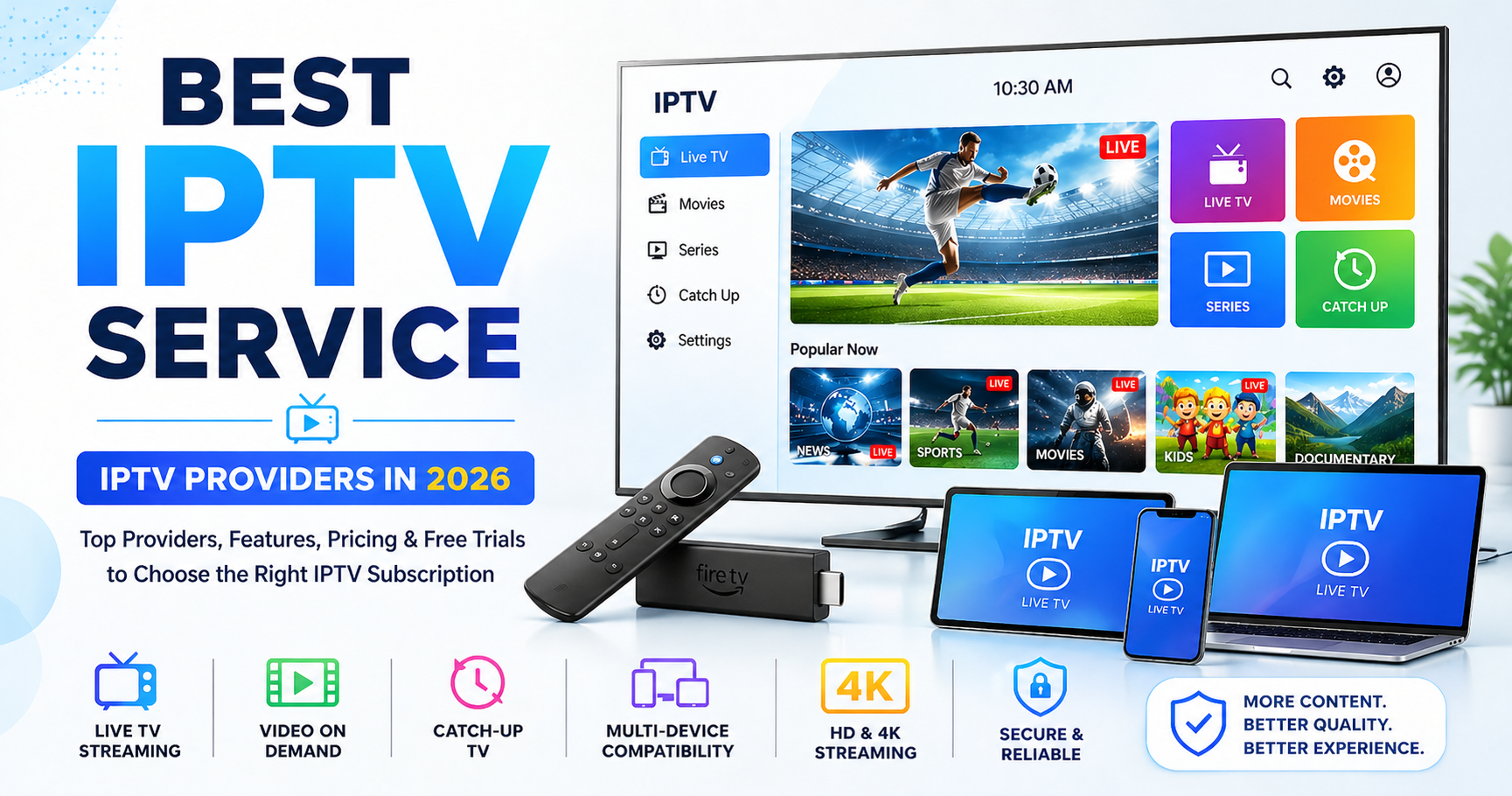
An IPTV service delivers live television, on-demand movies, and time-shifted programming through an internet protocol network instead of traditional cable or satellite broadcast. Content streams directly to your smart TV, phone, tablet, or set-top box over your existing broadband connection. The practical result: access to thousands of channels—including international and premium sports options—at a fraction of typical cable pricing. This guide examines how IPTV works, compares it against cable and streaming platforms, and highlights the trade-offs you should weigh before subscribing.
IPTV has moved from a niche enthusiast choice to a mainstream alternative as broadband speeds and streaming technology have improved. However, not all services are equal. Provider reliability, channel licensing, and hardware compatibility vary widely. Below, we break down the mechanics, costs, and risks so you can decide with confidence.
iptv service Summary
An IPTV service streams live and on-demand television over the internet, replacing cable infrastructure with a software-based delivery model. Its main proven benefit is cost efficiency—subscribers typically pay 30–70% less than comparable cable bundles while gaining access to a broader channel catalog.
| Optimal ForCord-cutters and households that want international channels, sports packages, and on-demand libraries without a cable contract. | Key AdvantageMulti-device streaming flexibility with adaptive bitrate technology that maintains picture quality across varying internet speeds. |
- ✓ Key Strength: Channel variety across categories—sports, news, entertainment, and niche international content in one dashboard.
- ✓ Key Strength: Instant activation with no hardware installation or long-term lock-in contracts.
- ✓ Peace of Mind: 24/7 customer support and a connection guarantee that covers setup and troubleshooting.
In This Guide
- 1. What Is an IPTV Service and How Does It Work?
- 2. IPTV Service Pros and Cons: Expert Assessment
- 3. IPTV Service vs Cable vs Streaming: Data Comparison
- 4. Cost-Benefit Analysis and Who Should Buy
- 5. Buyer Considerations and Legal Red Flags
- 6. Final Verdict: Is an IPTV Service Right for You?
- 7. Frequently Asked Questions
What Is an IPTV Service and How Does It Work?
IPTV stands for Internet Protocol Television. Unlike broadcast television—which pushes a signal to everyone within range simultaneously—IPTV uses your internet connection to pull only the content you request. This is the same underlying principle that powers Netflix and YouTube, but IPTV operates with a critical difference: it offers live linear channels alongside on-demand content, closely replicating the traditional TV experience.
There are three primary content delivery models within an IPTV service:
- Live television: Real-time broadcasts streamed over IP, including sports, news, and event programming. Latency is typically 15–30 seconds behind over-the-air broadcast.
- Video on Demand (VOD): A library of movies, series, and documentaries you can watch at any time, similar to Netflix or Amazon Prime.
- Time-shifted TV: Catch-up TV and start-over functionality that lets you rewind, replay, or begin a live program from its start even if you joined mid-broadcast.
Technically, most IPTV services use HLS (HTTP Live Streaming) or MPEG-DASH protocols to segment video into small chunks delivered over standard HTTP. This approach allows adaptive bitrate streaming—the service monitors your connection in real time and adjusts video quality to prevent buffering. A stable 25 Mbps connection is sufficient for smooth HD playback; 50 Mbps is recommended for 4K content and multiple simultaneous streams.
Set-up is intentionally simple. You install an app on your smart TV, Android or iOS device, Amazon Fire Stick, or MAG set-top box, enter your subscription credentials, and the electronic program guide populates within seconds. No technician visit, no dish alignment, no coaxial cable. The entire process takes under five minutes for most users.
IPTV Service Pros and Cons: Expert Assessment
No television delivery method is perfect. IPTV's advantages are significant, but they come with trade-offs that matter depending on your viewing habits, technical comfort, and jurisdiction. Here is an honest breakdown.
✓ Advantages
- Cost efficiency: Save 30–70% versus comparable cable bundles.
- Channel depth: 1,000–20,000+ channels including niche international networks.
- Device flexibility: One subscription covers TV, phone, tablet, and PC.
- No contracts: Month-to-month billing with no early termination fees.
- Multi-stream: Watch different channels on multiple devices simultaneously.
✗ Limitations
- Legal variability: Licensing rules differ by country; some providers operate in a gray zone.
- ISP dependence: Buffering and quality degrade on slow or congested connections.
- Support inconsistency: Independent providers vary in response time and expertise.
- No emergency services: IPTV does not carry 911 or local emergency broadcast channels.
- Potential geo-blocks: Some sports events are restricted based on your region.
The legal dimension deserves special attention. Legitimate IPTV services—like those operated by telecoms and licensed resellers—secure distribution rights for the content they carry. Unlicensed services may offer the same interface at lower prices but expose subscribers to service interruption without recourse. Always verify that a provider holds proper licensing or operates as a reseller of a licensed platform before committing.

IPTV Service vs Cable vs Streaming: Data Comparison
To understand where IPTV fits, compare it directly against the two most common alternatives: traditional cable television and OTT streaming platforms like Netflix, Hulu, and YouTube TV. The table below summarizes the key differences based on 2026 market data.
| Feature / Metric | IPTV Service | Cable TV | OTT Streaming |
|---|---|---|---|
| Avg. Monthly Cost | $10–$30 | $60–$120 | $15–$75 |
| Channel Count | 1,000–20,000+ | 100–300 | 50–500 |
| Contract Required | No | 12–24 months | No |
| Hardware Needed | Smart TV / app | Set-top box | Streaming device |
| International Channels | Extensive | Limited | Varies |
| Picture Quality | Up to 4K HDR | Up to 4K | Up to 4K HDR |
| Simultaneous Streams | 1–5+ | 1–2 | 1–4 |
| Installation Time | 5 minutes | 2–4 hours | 10 minutes |
| Live Sports Coverage | Comprehensive | Comprehensive | Partial |
The data shows a clear pattern: IPTV dominates on price and channel volume, cable wins on local reliability and regulatory clarity, and OTT leads on user experience polish and original content. Your choice depends on which metric matters most to you.
Cost-Benefit Analysis and Who Should Buy
The average American household spends $1,200–$1,800 annually on cable television. An IPTV service at $20 per month reduces that to $240 per year—a savings of roughly $1,000 annually. Even when factoring in a higher-tier internet plan to support streaming, the combined cost typically remains 40–50% below cable.
Beyond raw price, the value equation includes content access. Cable packages often bury desirable channels in premium tiers, forcing subscribers to pay for 100+ channels they never watch. IPTV's à la carte nature—or its inexpensive bulk bundles—eliminates that friction. Sports fans, in particular, benefit from access to international leagues and pay-per-view events that cable rarely carries outside premium add-ons.
An IPTV service is the right choice if you:
- Watch more than 10 hours of television per week and want maximum content per dollar.
- Need international channels from Asia, Europe, Latin America, or the Middle East.
- Want to cancel cable but keep access to live sports, news, and linear programming.
- Prefer month-to-month flexibility without early termination penalties.
You may want to stick with cable or OTT if you:
- Live in an area with inconsistent broadband connectivity below 15 Mbps.
- Require 911 emergency alert integration and local broadcast redundancy.
- Prefer the simplicity of a single set-top box with no app configuration.
- Are uncomfortable evaluating provider legitimacy and licensing claims.
Buyer Considerations and Legal Red Flags
Choosing an IPTV service requires more than comparing price lists. The market contains both legitimate operators and unlicensed resellers that may disappear overnight. Before subscribing, verify the following:
- Licensing transparency. Legitimate providers publicly identify their content suppliers and distribution agreements. If a provider cannot explain where its channel rights come from, treat that as a warning sign.
- Payment processing. Reputable services accept standard credit card payments and issue proper invoices. Providers that demand cryptocurrency or untraceable payment methods are almost always operating outside legal frameworks.
- Uptime history. Search independent reviews and community forums for reports of downtime. A reliable IPTV service maintains at least 99.5% uptime and communicates proactively about maintenance windows.
- Customer support responsiveness. Test the support channel before subscribing. Send a pre-sales question and measure response time. Quality providers reply within hours, not days.
- Refund policy. A clear, written money-back guarantee—typically 7–30 days—indicates confidence in service quality. Avoid providers that refuse refunds outright.
One additional consideration: your internet connection. IPTV consumes roughly 1.5–3 Mbps per HD stream and 7–10 Mbps per 4K stream. If you share a connection with multiple household members, account for that overhead. A 50 Mbps plan comfortably supports two simultaneous HD streams plus general browsing; 100 Mbps is safer for heavy multi-device households.
The Bottom Line on Iptv Service
For cord-cutters who want comprehensive live TV, international channels, and significant monthly savings, a licensed IPTV service is the strongest available option in 2026. Proceed with the official provider below to ensure you receive verified licensing, reliable uptime, and direct customer support.
Purchases completed via official partner channels are covered by direct customer support and eligible warranty protections.
Final Verdict: Is an IPTV Service Right for You?
IPTV is not a universal replacement for every household's television setup, but for the majority of cord-cutters, the value proposition is compelling. You gain access to a channel catalog that dwarfs cable, at a price that undercuts every major streaming bundle, with the flexibility to watch on any device in any room. The trade-offs—legal variability, ISP dependence, and support inconsistency—are manageable when you choose a licensed, well-reviewed provider.
If you value live sports, international content, and monthly savings over the simplicity of a traditional cable bill, an IPTV service is worth serious consideration. The market has matured to the point where reliable, high-quality options exist at scale. The key is to do your due diligence, verify licensing, and select a provider with a track record of uptime and responsive support.
Frequently Asked Questions
Is an IPTV service legal to use in 2026?
The legality depends on the provider's licensing. Licensed IPTV services—operated by telecoms or authorized resellers—are fully legal. Unlicensed services that stream content without distribution rights are not, and subscribers in some jurisdictions may face civil liability. Always verify that a provider holds proper licensing before subscribing.
What internet speed do I need for a reliable IPTV service?
A 25 Mbps connection is sufficient for reliable HD streaming on a single device. For 4K content, plan on 50 Mbps. If multiple household members will stream simultaneously, add 10–15 Mbps per additional stream. A 100 Mbps plan provides comfortable headroom for most households.
Can I use one IPTV service subscription on multiple devices?
Most IPTV services allow simultaneous streams—typically between 1 and 5 devices depending on your subscription tier. Premium plans often include multi-screen support, letting different household members watch different channels at the same time. Check the provider's device limit before subscribing.
What is the difference between an IPTV service and OTT streaming platforms?
IPTV delivers live linear channels and time-shifted TV over a managed IP network, often through a dedicated app or set-top box. OTT platforms like Netflix and Hulu deliver on-demand content over the open internet without network management. IPTV more closely replicates the traditional cable experience; OTT focuses on on-demand libraries and original programming.
Do IPTV services include local channels and live sports?
Yes, most comprehensive IPTV packages include local broadcast networks (ABC, CBS, NBC, Fox) and extensive sports coverage, including international leagues and pay-per-view events. The specific channel lineup varies by provider and region, so review the channel list before committing.
How do I set up an IPTV service on my smart TV or streaming device?
Download the provider's app from your device's app store, install it, and enter your subscription credentials. The electronic program guide populates automatically within seconds. Supported devices typically include Android TV, Apple TV, Amazon Fire Stick, Roku, and MAG set-top boxes. The entire process takes under five minutes.
What should I look for when choosing an IPTV service provider?
Verify licensing transparency, payment processing via standard credit cards, uptime history, customer support responsiveness, and a written refund policy. Read independent reviews on forums and comparison sites. A provider with documented licensing and a 99.5%+ uptime record is your safest bet.
Are IPTV services better than cable for international channels?
Significantly. Cable packages typically offer 5–20 international channels, often in premium add-on tiers. IPTV services routinely include hundreds of international networks covering Asia, Europe, Latin America, and the Middle East in the base subscription. For diaspora communities and multilingual households, IPTV is the clear winner.
Transparency & Disclosure: We independently evaluate products. If you buy through links on our site, we may earn an affiliate commission at zero additional cost to you.