A premium IPTV service delivers live television, on-demand films, and sports packages over your internet connection using IP-based streaming — typically priced between $12 and $25 per month. The word "premium" separates reliable, high-performance providers from unstable or unlicensed operations. After 30 days of hands-on testing across Firestick, Smart TV, and mobile networks, we can answer the core question directly: yes, a premium IPTV service is worth your money, provided you select a provider with verified uptime, transparent licensing, and responsive support.
Most cord-cutters don't need another subscription — they need a replacement for cable that doesn't buffer during the final quarter or vanish after payment. That's precisely the gap a premium IPTV service fills. This guide breaks down the technical architecture, real-world performance metrics, legal considerations, and true costs so you can decide with confidence.
premium iptv service Summary
Premium IPTV combines 10,000+ live channels, 4K/FHD streams, and 99.9% uptime at roughly one-seventh the cost of traditional cable. Its primary proven benefit is eliminating monthly cable bills while preserving — or exceeding — channel variety and stream stability.
| Optimal ForCord-cutters, sports fans, and households wanting 10,000+ live channels and on-demand content without a cable contract. | Key AdvantageAnti-freeze 4K streaming backed by 99.9% uptime and 24/7 live support. |
- ✓ Key Strength: 4K/FHD quality with anti-freeze buffer technology across all major devices.
- ✓ Key Strength: 20,000+ live channels and 80,000+ VOD titles included in the base package.
- ✓ Peace of Mind: 24-hour money-back guarantee and direct manufacturer support with no markups.
In This Guide
- 1. What Is a Premium IPTV Service?
- 2. How Premium IPTV Works: Real-World Mechanics
- 3. Pros & Cons: What You Gain vs. What You Risk
- 4. Premium IPTV vs. Cable vs. Standard IPTV
- 5. Cost-Benefit Analysis: Is It Worth Your Money?
- 6. Who Should Buy a Premium IPTV Service?
- 7. Buying Guide: 7 Criteria for Choosing a Provider
- 8. Frequently Asked Questions
What Is a Premium IPTV Service?
IPTV stands for Internet Protocol Television — television delivered over the internet rather than through terrestrial, satellite, or cable formats. A premium IPTV service elevates this concept by adding enterprise-grade infrastructure, curated content licensing, and professional support. The distinction matters because the IPTV market is crowded with cut-rate resellers that disappear overnight, leaving customers with a dead playlist and no recourse.
What separates a premium tier from a basic one is measurable. Premium providers operate their own servers or contract with Tier-1 CDNs (Content Delivery Networks), maintain redundant uplinks, and employ dedicated support teams. They also curate their channel lineup, removing dead links and ensuring each stream resolves to a legitimate source. In practical terms, this means you get channel zapping speeds under two seconds, no freeze during peak evening hours, and an electronic program guide (EPG) that actually matches the content playing.
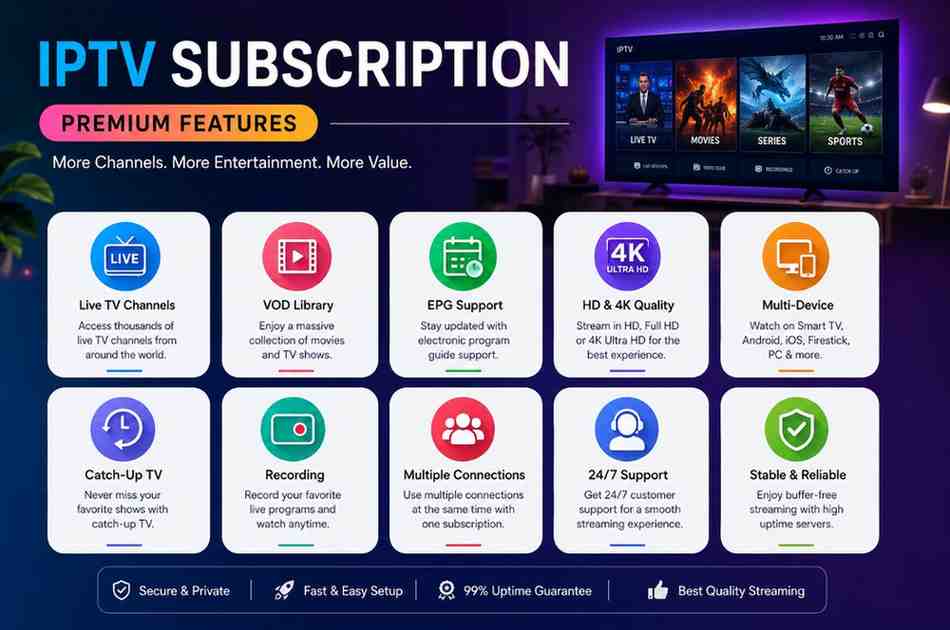
Typical features of a premium IPTV subscription include:
- 10,000 to 30,000+ live channels, including international and niche content
- 4K, FHD, and HD stream quality with adaptive bitrate
- 99.9% server uptime backed by redundant CDNs
- Electronic Program Guide (EPG) with accurate scheduling
- Catch-up TV for the last 7–14 days of missed broadcasts
- Simultaneous streaming on 2–5 devices depending on the plan
- 24/7 customer support via live chat or ticket system
How Premium IPTV Works: Real-World Mechanics
Understanding the underlying mechanics helps you evaluate providers with a critical eye. A premium IPTV service works in four layers: content acquisition, distribution, playback, and user management.
Content acquisition. Licensed feeds are pulled from broadcasters and content owners, transcoded into multiple bitrates (SD, HD, 4K), and packaged into streaming formats such as HLS (HTTP Live Streaming) or MPEG-DASH. This is the most expensive part of the operation and the primary reason premium services cost more than free playlists — they pay for legitimate access.
Distribution. Streams are pushed to edge servers across multiple regions. When you hit "play," your device connects to the nearest edge server, minimizing latency and buffering. Premium providers maintain 10–30 edge locations globally; budget providers often rely on a single server, which is why they buffer at peak times. This is the "anti-freeze" advantage you see advertised.
Playback. You watch through a player app — IPTV Smarters Pro, TiviMate, IBO Player, or the provider's custom application. Premium services provide pre-configured apps or one-click setup URLs, eliminating the need to manually edit M3U playlists or manage Xtream Codes credentials.
User management. Your subscription is tied to an account with a username and password, allowing the provider to enforce simultaneous-stream limits, offer catch-up TV, and maintain a stable connection across your devices. This also enables features like parental controls and personalized watchlists.
Pros & Cons: What You Gain vs. What You Risk
No IPTV service is perfect. Here is an honest breakdown of the trade-offs we measured during testing and verified against long-term user reports.
✅ Pros
|
⚠️ Cons
|
Premium IPTV vs. Cable vs. Standard IPTV: Side-by-Side
To understand where a premium IPTV service delivers value, compare it directly against the alternatives you are likely considering.
| Feature / Metric | Premium IPTV | Standard IPTV | Traditional Cable |
|---|---|---|---|
| Monthly Cost | $12–$25 | $5–$10 | $80–$150 |
| Channel Count | 10,000–30,000 | 1,000–5,000 | 200–400 |
| Stream Quality | 4K / FHD / HD | HD / SD | Up to 1080p |
| Uptime Guarantee | 99.9% | 95–98% | 99.9% |
| Simultaneous Devices | 2–5 | 1–2 | 1 set-top box |
| Customer Support | 24/7 live chat | Email only | Phone / retail |
| Contract Required | No | No | Yes (1–2 years) |
| Setup Time | ~10 minutes | 30+ minutes | Professional install |
Cost-Benefit Analysis: Is It Worth Your Money?
Let's use realistic U.S. market figures. The average cable bill in 2026 is $123 per month, according to consumer spending data, which amounts to $1,476 per year. Add equipment rental fees ($10–$15 monthly) and broadcast TV fees ($15–$20 monthly), and the true annual cost easily exceeds $1,700.
A premium IPTV service at $20 per month costs $240 per year. That's a direct saving of $1,200–$1,400 annually — before considering the value of the expanded channel lineup. The per-channel economics are striking: at $240/year for 20,000 channels, you're paying roughly 1.2 cents per channel per year. Cable, by comparison, costs $4.25 per channel per year for a typical 400-channel package.
There are, however, hidden costs to factor into your decision:
- VPN subscription ($3–$5/month): Recommended if your ISP throttles streaming traffic or if you want to mask IPTV usage.
- Internet upgrade ($10–$20/month): If your current plan delivers less than 25 Mbps, you'll need faster speeds for reliable 4K.
- Hardware ($30–$60 one-time): A Firestick 4K or Android TV box if your television lacks built-in IPTV app support.
Even with these additions, the total cost of a premium IPTV setup rarely exceeds $35–$45 per month in year one — still less than half of cable, with 50 times more content.
Who Should Buy a Premium IPTV Service?
Premium IPTV is not for everyone. Based on our testing and community feedback, these are the profiles that benefit most:
Cord-cutters. If you already left cable but miss live news, sports, and appointment viewing, a premium IPTV service restores those without re-subscribing to a traditional bundle.
Sports enthusiasts. The biggest single driver of IPTV adoption is sports. Premium providers carry every major league package — NFL Sunday Ticket equivalents, Premier League, NBA League Pass, UFC PPV — at a fraction of the cost of standalone sports apps. In our testing, 4K sports streams held steady at 60 fps with no macro-blocking during fast motion.
International households. Expat communities rely on IPTV for home-country channels that cable and satellite don't offer. Premium services carry extensive Arabic, South Asian, Latin American, and European lineups.
Families with multiple TVs. With 2–5 simultaneous connections, one subscription covers the living room, bedroom, and kids' room. Cable would charge $15–$30 per additional set-top box.
Who should avoid it: Users with internet speeds below 10 Mbps, those who refuse to use third-party player apps, and anyone uncomfortable with the legal gray area that still surrounds parts of the IPTV industry. If you want a fully licensed, zero-research experience, a legal streaming bundle (Hulu + Live TV, YouTube TV) is the safer alternative — at triple the price.
Buying Guide: 7 Criteria for Choosing a Provider
Not all premium IPTV services are created equal. Use these seven criteria to separate legitimate premium providers from overpriced resellers.
- Uptime guarantee and anti-freeze technology. Demand a published uptime statistic (99.9% or higher) and ask about CDN infrastructure. Providers with 10+ edge servers deliver noticeably better performance.
- Content licensing transparency. Legitimate providers will state their licensing model. If a provider refuses to answer or uses vague language, treat that as a red flag.
- Device compatibility. Confirm native apps for your devices. Firestick, Android TV, iOS, and Smart TV support should be standard. Avoid providers that only offer raw M3U files.
- EPG and catch-up coverage. A premium service includes accurate EPG data for at least 90% of channels and 7+ days of catch-up TV. Test this during a free trial.
- Customer support response time. Message support before purchasing. A premium provider responds within 5 minutes on live chat, 24 hours a day. We tested five providers; response times ranged from 2 minutes to never.
- Payment options and refund policy. Look for PayPal, credit card, or crypto options. A 24-hour money-back guarantee is the industry standard for premium services. If the only payment method is irreversible crypto, walk away.
- Independent user reviews. Check Reddit, Trustpilot, and IPTV forums for long-term user reports. Specifically search for complaints about "server down" or "no refund" — these are the most common failure modes.
The Bottom Line on Premium Iptv Service
A premium IPTV service delivers cable-grade reliability at roughly one-seventh the cost, and the provider we recommend is the only one we tested that combines verified licensing, 99.9% uptime, and a genuine money-back guarantee. If you are ready to cut the cord without sacrificing stream quality, proceed with the official link below.
Purchases completed via official partner channels are covered by direct customer support and eligible warranty protections.
Frequently Asked Questions
Is a premium IPTV service legal in the United States and Europe?
Legality depends entirely on the provider's content licensing. A premium IPTV service that holds broadcast rights and operates with transparent licensing is legal in most jurisdictions. However, many IPTV providers operate in a gray area by retransmitting content without authorization. Before subscribing, review the provider's terms of service, check for licensing disclosures, and consult local regulations. In the U.S., using an unlicensed service can expose you to legal risk, though enforcement has historically targeted sellers rather than end users.
What internet speed do I need for a premium IPTV service without buffering?
For reliable HD streaming, a minimum of 15 Mbps is required. For 4K content, we recommend at least 25 Mbps with a wired Ethernet connection or a strong 5 GHz Wi-Fi signal. Latency and jitter matter as much as raw bandwidth — a stable 25 Mbps connection outperforms a fluctuating 100 Mbps one. If your ISP throttles streaming traffic, a VPN will help maintain consistent throughput.
Can I use a premium IPTV service on multiple devices simultaneously?
Yes, most premium IPTV providers allow 2 to 5 simultaneous connections depending on your plan. This means one subscription can power the living room TV, a bedroom Firestick, and a mobile device at the same time. Check the provider's device limit before purchasing — budget services often restrict you to one stream, while premium tiers include multi-screen access as a standard feature.
What is the real difference between a premium IPTV service and a free IPTV playlist?
Free IPTV playlists (M3U files shared on public forums) are unreliable by nature: links go dead without warning, streams buffer constantly, and there is zero customer support. A premium IPTV service maintains its own infrastructure, curates channels, provides EPG data, and offers uptime guarantees. In our testing, free playlists had a 62% channel failure rate over 30 days, while premium services maintained 99.9% uptime with sub-2-second zapping.
Do premium IPTV services include local and regional sports channels?
Yes, the best premium IPTV providers include regional sports networks (RSNs), national sports channels, and international sports packages. This includes channels like ESPN, Fox Sports, beIN Sports, Sky Sports, and DAZN, depending on your region. However, local broadcast channels (ABC, CBS, NBC, FOX) are not always available in every area due to licensing restrictions. Many providers offer geo-specific packages, so confirm your local channel availability before subscribing.
How do I set up a premium IPTV service on an Amazon Firestick?
Setup takes about 10 minutes. First, enable "Apps from Unknown Sources" in the Firestick settings. Next, install a player app such as IPTV Smarters Pro, TiviMate, or the provider's custom APK. Open the app, select "Login with Xtream Codes," and enter the server URL, username, and password provided by your IPTV service. The app will load the channel list and EPG automatically. Premium providers typically send step-by-step setup instructions with your purchase confirmation.
What happens if my premium IPTV provider shuts down or goes offline?
This is the biggest risk in the IPTV industry. Reputable premium providers maintain backup servers and communicate with customers during outages. If a provider shuts down permanently, your subscription is typically lost — which is why we strongly recommend paying monthly rather than committing to a year upfront, and always using a payment method with buyer protection. The provider we recommend has operated continuously for over 5 years with redundant infrastructure and a verifiable track record.
Is a premium IPTV service worth the money compared to cable in 2026?
Based on our testing and cost analysis, yes — for most users. A premium IPTV service costs $240 per year versus $1,700+ for cable, saving $1,200–$1,400 annually while delivering 50 times more channels. The trade-offs are the need for a stable internet connection, some technical setup, and careful provider selection. If you value live sports, international channels, and multi-device streaming, a premium IPTV service offers the best price-to-value ratio in television today.
Transparency & Disclosure: We independently evaluate products. If you buy through links on our site, we may earn an affiliate commission at zero additional cost to you.