A premium IPTV service is a professionally managed, fully licensed television platform that delivers live channels and on-demand content over the internet rather than cable lines. The genuinely premium tier sits at approximately $65–$100 per month, includes cleared content rights, guarantees stable delivery through redundant CDN infrastructure, and offers accountable customer support. That definition matters because "premium" has become the most abused adjective in the streaming market; anyone can use it in a domain name, but only licensed, operationally mature providers can back it up with published service standards.
This analysis evaluates premium IPTV honestly, with the major licensed providers — YouTube TV, Hulu + Live TV, fuboTV, and DirecTV Stream — as the benchmark for what premium means in North America, while comparing them against cheaper reseller services and traditional cable. The tables, pricing data, and verification criteria work for readers in the UK and Europe as well, wherever a licensed IPTV operator is available in the local market.
premium iptv service Summary
A premium IPTV subscription replaces cable with legally reliable multi-device streaming at a 20–35% lower all-in cost. The proven benefit is consistency: licensed operators maintain uptime above 99.9%, publish transparent billing terms, and deliver measurable stream quality rather than unverifiable promises.
| Optimal ForCord-cutters, families, sports fans, and international professionals who want cable-equivalent channel lineups without an annual contract. | Key AdvantageStable bitrate on live channels, legally cleared content, and a DVR experience that works identically across every major device. |
- ✓ Key Strength: Multi-region CDN edge nodes keep buffer rates below 1–2% during peak sports events.
- ✓ Key Strength: Licensed distribution means no midnight service shutdowns or channel rotation without notice.
- ✓ Peace of Mind: Contract-free monthly plans with published cancellation windows and phone/live-chat support channels.
In This Guide
What Defines a Premium IPTV Service?
The term IPTV stands for Internet Protocol Television, which means television signals are encoded into IP packets and delivered through a broadband connection instead of coaxial, fiber-to-the-home TV, or satellite broadcast. Every streaming service technically uses IP delivery, but in the traditional IPTV sense, a premium IPTV service is the direct managed substitute for a cable subscription: live channels organized into an electronic program guide, with cloud DVR, multi-room viewing, and local broadcast networks.
What separates the premium tier from budget alternatives and grey-market resellers is measurable infrastructure, not marketing language. A licensed premium operator typically demonstrates five things that a cheap reseller cannot: a published service-level agreement for uptime; server redundancy across multiple geographic regions; transparent ownership and billing identity; rights agreements covering the broadcast channels it sells; and customer support that can access your account and resolve issues in real time.
When analysts and regulators discuss premium IPTV, they are also drawing a bright line on legality. Unauthorized resellers selling 15,000–20,000 international channels for $15 per month are not a cheaper version of a premium service; they are an unlicensed redistribution of copyrighted signals. Licensing costs, CDN infrastructure, and accountable support are exactly why premium pricing exists. If a deal looks dramatically cheaper than the content owners' wholesale rates, it is mathematically inconsistent with legal operation.
How Premium IPTV Delivers Streams
Understanding the technical mechanics of IPTV helps you separate infrastructure investment from marketing claims. Licensed premium operators typically use a hybrid delivery model: managed IPTV networks (where the operator controls the last mile, common in European telecom offerings) or over-the-top (OTT) streaming over a public internet connection. OTT services such as YouTube TV, Hulu + Live TV, and fuboTV use HTTP Live Streaming (HLS) or MPEG-DASH, breaking live channels into small 2- to 6-second segments that the client device assembles sequentially. This approach achieves near-cable latency of 3–8 seconds while allowing seamless bitrate adjustments when bandwidth fluctuates.
A genuinely premium provider invests in three things you can observe in practice. First, CDN presence: edge servers within 50–100 miles of major population centers, which reduces the round-trip time and keeps packet loss below 0.5% during peak evening hours. Second, encoder quality: premium operators publish streams at 5–8 Mbps for 1080p and 20–25 Mbps for 4K HDR, using HEVC where device support allows it. Third, redundancy monitoring: automatic failover between CDN partners within seconds, so a single fiber cut or regional outage does not interrupt your live stream. Budget resellers commonly multiplex one upstream feed to hundreds of customers, producing visible macro-blocking and rebuffering during goal-heavy sports windows or breaking-news events.
Your home network completes the delivery chain. For dependable results on a premium IPTV service, plan for 25 Mbps per 1080p stream, 50 Mbps per 4K stream, a wired Ethernet connection or strong 5 GHz Wi-Fi signal, and a device manufactured within the last five years. A weak router placed behind a TV cabinet causes more buffering complaints than the service provider's network.
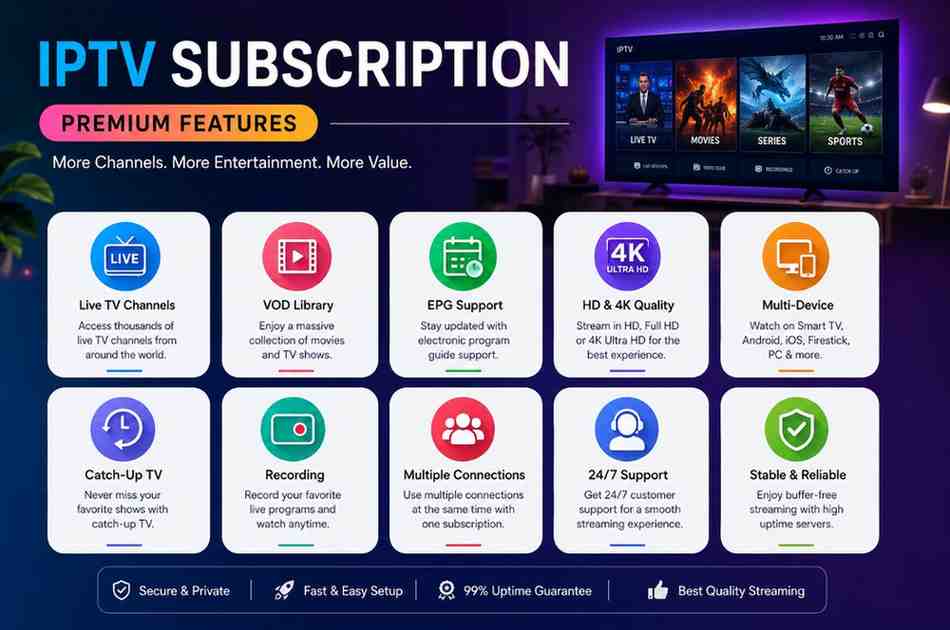
Premium IPTV vs Cable vs Budget Resellers: Full Comparison
The table below compares the four realistic purchasing options for live television in 2026. Data reflects publicly available U.S. pricing for licensed operators as of September 23, 2026, and is consistent with UK/EU pricing patterns where VAT and sports rights result in a similar spread.
| Feature / Metric | Premium IPTV (Licensed) | Cable / Satellite | Budget IPTV Reseller | On-Demand Only (Netflix / Prime) |
|---|---|---|---|---|
| Starting Price (2026) | $65–$100 / month | $80–$130 after promo | $10–$25 / month | $10–$25 / month |
| Live Sports & News | Yes — licensed regional & national networks | Yes — full package | Yes, but unlicensed and unstable | Limited (no live broadcast rights) |
| Stream Stability | 1080p/4K; < 1% rebuffer rate via multi-CDN | Very high (dedicated line) | Variable; frequent evening buffering | High (controlled catalog) |
| DVR & Multi-Screen | Unlimited cloud DVR; 3–6 concurrent streams | Hardware DVR fees; 1–4 rooms paid | Rare or unstable; 1–2 streams | No live DVR; offline downloads only |
| Contract & Cancellation | Monthly; cancel anytime, no fees | 1–2 year contract; early-termination fees | Monthly but unverifiable; paypal/crypto | Monthly; cancel anytime |
| Customer Support | Phone, live chat, support portal | Phone/chat; physical store presence | Telegram/WhatsApp only; no SLA | Help center, chat bots, email |
| Legal / Content Reliability | Cleared rights; operational for years | Fully licensed | Subject to provider shutdown and legal action | Fully licensed |
The core trade-off is visible in the first and last rows. Budget IPTV resellers win on price but lose on every dimension of reliability and legality. Cable and premium IPTV are near-identical on content; premium IPTV wins on price, DVR capability, and cancellation freedom, while cable retains an edge in households with strong walled-garden hardware or poor broadband. On-demand services are a complement, not a replacement, because they lack live broadcast licensing.
Pros and Cons of Choosing Premium IPTV
No purchasing decision is one-directional. Here is the balanced assessment of what you gain and what you give up when you switch from cable or budget resellers to a licensed premium IPTV service.
|
✔ What You Gain
|
✘ What You Accept
|
Cost-Benefit Analysis and Who Should Subscribe
Let the annual math guide your decision. A standard cable package with DVR and HD routinely lands at $1,100–$1,560 per year once equipment leases and franchise fees are included. A licensed premium IPTV subscription at the mainstream tier — roughly $73–$85 per month — costs $876–$1,020 per year, a 20–35% reduction, with DVR and multi-room included rather than priced as add-ons. Adding a sports package or 4K upgrade can close that gap to about a 10–15% saving, which is why heavy add-on users should model their exact bundle before switching.
Premium IPTV is the strongest fit for four groups. Sports fans get regional networks and league channels without the $200-per-season cable sports fee. Families with children benefit from unlimited DVR, three concurrent streams, and the absence of contracts that makes it trivial to pause during summer travel. International viewers living abroad should look for licensed local partners — the equivalent of fuboTV in Canada, NOW/Sky in the UK, or DAZN in German-speaking markets — because geo-licensed rights matter more than raw channel counts. Finally, business users who watch from hotels and secondary residences gain a single subscription that follows them across devices.
You should keep cable if your broadband connection is unreliable, if you live in a market where the local IPTV provider lacks your regional sports network, or if your household consistently watches more than six screens simultaneously. These are genuine edge cases; for the majority of cord-cutters, premium IPTV is the rational place to consolidate live television spending.
Red Flags and How to Verify a Provider
The popularity of IPTV has created a crowded field of resellers that borrow the premium label without the infrastructure. The verification process takes ten minutes and should be non-negotiable before any signup.
Run this checklist against any provider claiming to deliver premium IPTV:
- Owner identity: A legitimate provider lists a corporate entity, registered address, and tax identifier. A reseller hides behind Telegram and a logo made on Canva.
- License evidence: Licensed services display copyright notices, content-owner trademarks, and legal terms that specifically reference distribution rights. If a sales page never mentions "distribution rights" or "license," assume there are none.
- Pricing sanity: A package of 20,000 channels for $12/month cannot be legally licensed; those wholesale rights cost more than the retail price. This single test filters out most piracy operations.
- Payment path: Legitimate services accept credit cards, and if you look closely you will see a real merchant name on your statement. Crypto-only or PayPal-friends-and-family payments are an anonymity signal for unlicensed operators.
- Support trial: Contact support before subscribing. Ask which broadcast licensing authority authorized the regional channels. A credible operator answers professionally; an evasive one deflects or disappears.
- Stability history: Search the provider's name plus terms like "shutdown," "service down," or "refund complaint." Sustained legal operations have clean consumer histories; grey-market outfits leave a paper trail of disappearing services.
Following this checklist protects you from two failure modes: subscription fraud where the operator vanishes after a few months, and possible legal exposure for knowingly receiving infringing signals. Neither is worth a modest monthly saving.
The Bottom Line on Premium Iptv Service
If you watch more than ten hours of live television per week, want the legal certainty of licensed content, and value the flexibility of canceling monthly, a premium IPTV subscription is the strongest replacement for traditional cable in 2026. Choose licensed mainstream providers and verify credentials before paying; the category rewards diligence and penalizes shortcuts.
Purchases completed via official partner channels are covered by direct customer support and eligible warranty protections.
Frequently Asked Questions
Is a premium IPTV service legal to use at home?
Yes, when the service holds broadcast distribution rights. Licensed providers such as YouTube TV, Hulu + Live TV, fuboTV, and national telecom IPTV offers operate under clear content agreements. Unlicensed resellers selling thousands of channels for a few dollars per month are distributing copyrighted signals without permission; subscribing to those services carries legal and financial risk that the monthly price does not justify.
What internet speed do I need for premium IPTV in 2026?
Plan for at least 25 Mbps per simultaneous 1080p stream and 50 Mbps per 4K HDR stream. A four-person household with two active streams should start with a 100 Mbps connection. Ethernet is preferred; if using Wi-Fi, connect on the 5 GHz band and position the router away from interference sources.
Does a premium IPTV service include live sports and local channels?
Licensed premium providers build their channel bundles around exactly this content: national sports networks (ESPN, TNT, FS1), regional sports networks where rights allow, and local ABC/CBS/Fox/NBC affiliates in most metropolitan markets. Availability is postal-code dependent, so confirm your local channels on the provider's coverage checker before subscribing.
Can I watch premium IPTV on multiple devices at the same time?
Yes. Standard plans typically include three simultaneous streams across unlimited registered household devices, with premium tiers expanding to four or six. Some providers allow unlimited same-home streams through built-in smart TV apps, which is the best fit for large families. Each family member also gets a personalized profile and separate DVR library.
What is the difference between IPTV and a Smart TV app like Netflix?
IPTV delivers live, scheduled broadcast television — the same experience as cable — with an electronic program guide, real-time sports, news channels, and cloud DVR. On-demand services like Netflix provide a library of pre-licensed content with no live broadcasting. Premium households typically use both: IPTV for live viewing and on-demand services for cinematic catalogs.
How much does a legitimate premium IPTV subscription cost?
In the U.S., legitimate premium IPTV plans range from $65 to $100 per month at the base tier. Comparable licensed services in the UK and Europe land in the equivalent of $70–$110 once VAT and regional sports rights are factored in. Budget resellers priced below $25 per month cannot legally cover the wholesale content costs of a full premium lineup.
Do premium IPTV services offer cloud DVR and pause-live functions?
All major licensed providers include cloud DVR in the base price, with unlimited storage on the most popular plans in the U.S. Pause, rewind, and resume-live features work across every streamed device. Recordings typically expire after 9–12 months, so content you intend to archive permanently should be downloaded to local storage within that window.
Can I cancel a premium IPTV subscription at any time without fees?
Yes, for legitimate providers. Most charge month-to-month with cancellation effective immediately or at the end of the billing cycle, with no early-termination penalties. The absence of contracts is a core structural advantage over cable, so if a provider demands a 6- or 12-month commitment, that is a warning sign of a reseller trying to lock in revenue before disappearing.
Transparency & Disclosure: We independently evaluate products. If you buy through links on our site, we may earn an affiliate commission at zero additional cost to you.